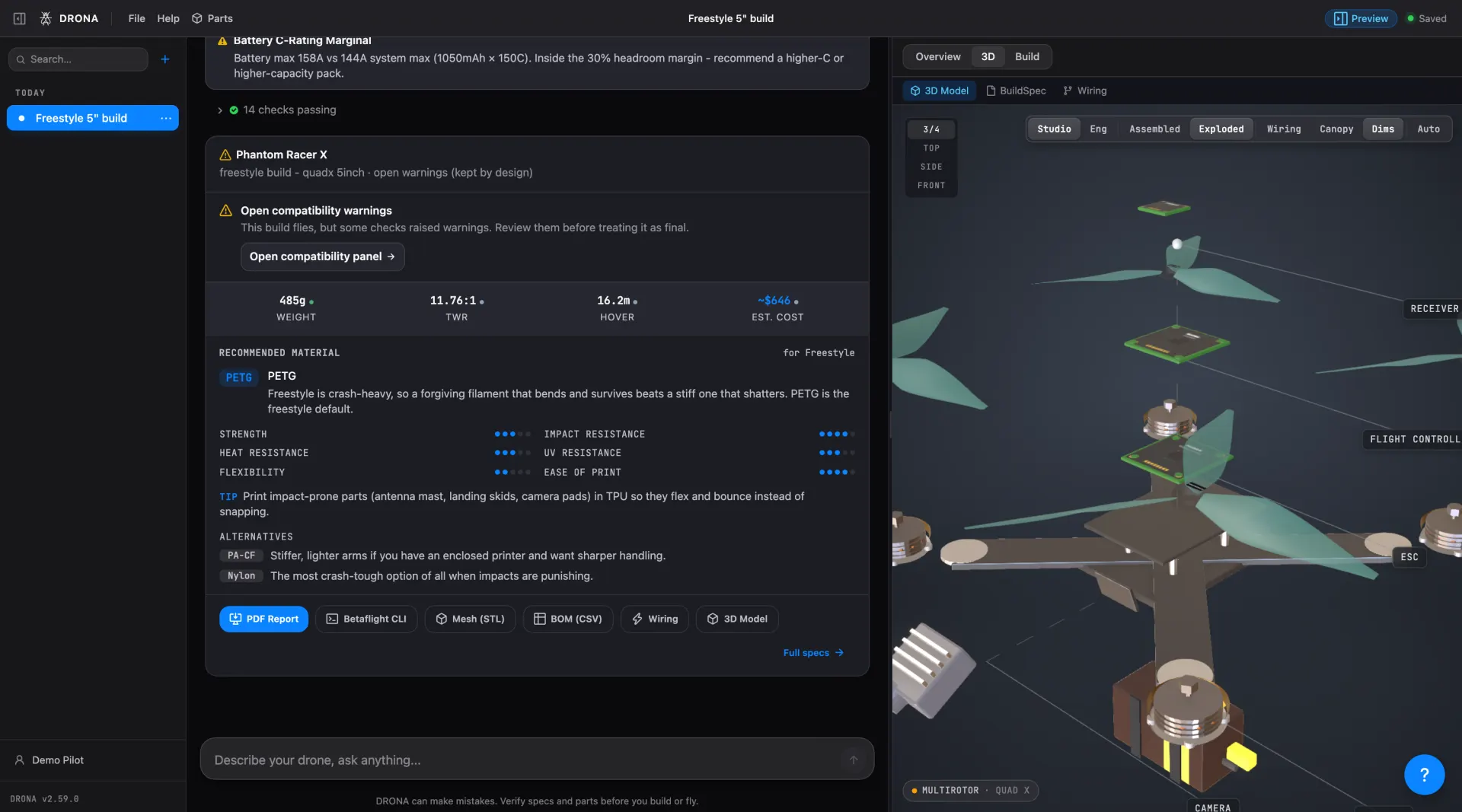
Drone hardware grew 18× in a decade. The software that designs it did not. DRONA is the AI-native design environment for every flying machine — the layer every builder, operator, and fleet will live inside by 2030. We are raising our seed round. This page is the room.
Every generation of hardware gets a new design layer. Mechanical got AutoCAD. Electrical got Altium. Chips got Cadence. Interfaces got Figma. Real-time got Unity. Each layer collapsed a multi-week artisanal process into a multi-hour conversation — and each layer grew a $10B+ category beneath it.
Drones do not have that layer. They have fifteen browser tabs, a forum thread from 2019, and a pile of datasheets. DRONA is the layer. Describe the job — watch the machine assemble — ship a validated build. One conversation. One artifact. One standard.
The drone is only the first machine. The architecture — chat as interface, physics as authority, catalog as truth — extends to every buildable thing in the sky, on the water, underground, and eventually on other planets. This is the conversation layer for physical systems. Drones are the wedge.
Commercial drone hardware + services, all segments. Conservative analysts project mid-teens CAGR; aggressive ones project ~30%. DRONA sits one layer up — the design and operations surface every builder and operator touches before they buy a part. Capture is measured in bps of hardware GMV, not headcount.
We do not sell drones. We sell the design layer — subscription per seat for prosumers, enterprise tier for operators, take rate on the BOM for marketplace flow. Three revenue surfaces, one product.
.vdx hits a sourcing surface. Retailer partner, not competitor — we route orders, they fulfil. Analog: Shopify payments.Structured tool-calling crossed the threshold where a language model can drive a typed physics engine without hallucinating. That is the wedge — chat as interface, physics as authority. Before 2024 this did not work. In 2026 it does.
Solar inspection grew from 200 MW/yr in 2019 to 28 GW in 2025. Agriculture went from hobbyist to $4.2B. BVLOS rules finally shipped in five major jurisdictions. The buyer exists, is spending, and does not want a hobbyist workflow.
DJI owns the hardware. Skydio owns the autonomy. Auterion owns the firmware. Nobody owns the conversation between "what do you need done" and "here is the machine." The layer is unclaimed, and the window is roughly 24 months.
.vdx spec users own. No lock-in is our moat, not our risk.Below: per-sector GMV that DRONA designs will touch by 2030, conservatively modelled at 0.5–2% of annual services spend. The full sheet is in the data room.
Every number above is the denominator. Our numerator — 0.5% to 2% of it — is what we are raising to capture. The math is in the data room; the thesis here is simple: DRONA does not pick a vertical — it picks all of them.
Names shared under NDA at first call.
We read every submission. We reply within 72 hours. We keep the round tight — four answers decide whether we set up a call.
Check your inbox for a confirmation and, if there's a fit, a calendar link within 72 hours. If you don't hear back, it is not a no — just a full queue. Nudge founders@drona.design.
It was, in 2016. In 2026, 74% of drone GMV is commercial — agriculture, inspection, mapping, delivery, public safety. The hobbyist is the entry gateway, not the ceiling. Our first enterprise contract will be larger than our first 200 prosumer seats combined.
They sell hardware. We sell the layer that routes orders to every hardware vendor. Our incentive is multi-vendor; theirs is single-vendor. A neutral design layer is orthogonal to their P&L — the same reason Figma wasn't built by Apple.
The model never speaks part numbers directly. It calls a typed tool against a verified catalog. Every returned SKU is tagged grounded, estimated, or conceptual. The compat engine is deterministic ECMAScript — the same module runs server and client. The architectural choice is permanent.
Hard no. It is in the system prompt, in the tool schemas, and in the manifesto. We will not help design weapons, loitering munitions, lethal autonomous systems, detection-evasion rigs for criminal use, or mass-targeting configurations. We are happy to keep that line bright even when it costs us customers.
We ship anyway, slower. We are currently default-alive at current burn through Q3 2026 with existing revenue. The round accelerates the enterprise tier and form-factor coverage — it does not keep the lights on.