Taxonomy

A taxonomy of unmanned systems, organized by lift principle.

Every design starts here. DRONA treats form factor as a first-class type parameter — not a label applied after the fact. The chat picks the form factor from the mission, the compatibility engine branches per form factor, the 3D viewer renders a per-form-factor model, and the specs engine computes specs via a per-form-factor dispatch. The seven production classes below cover the working drone universe. The niche and research sub-types at the bottom are documented for taxonomy completeness.

Shipping now Shipping Q2–Q3 2026 Later in 2026 Research / niche

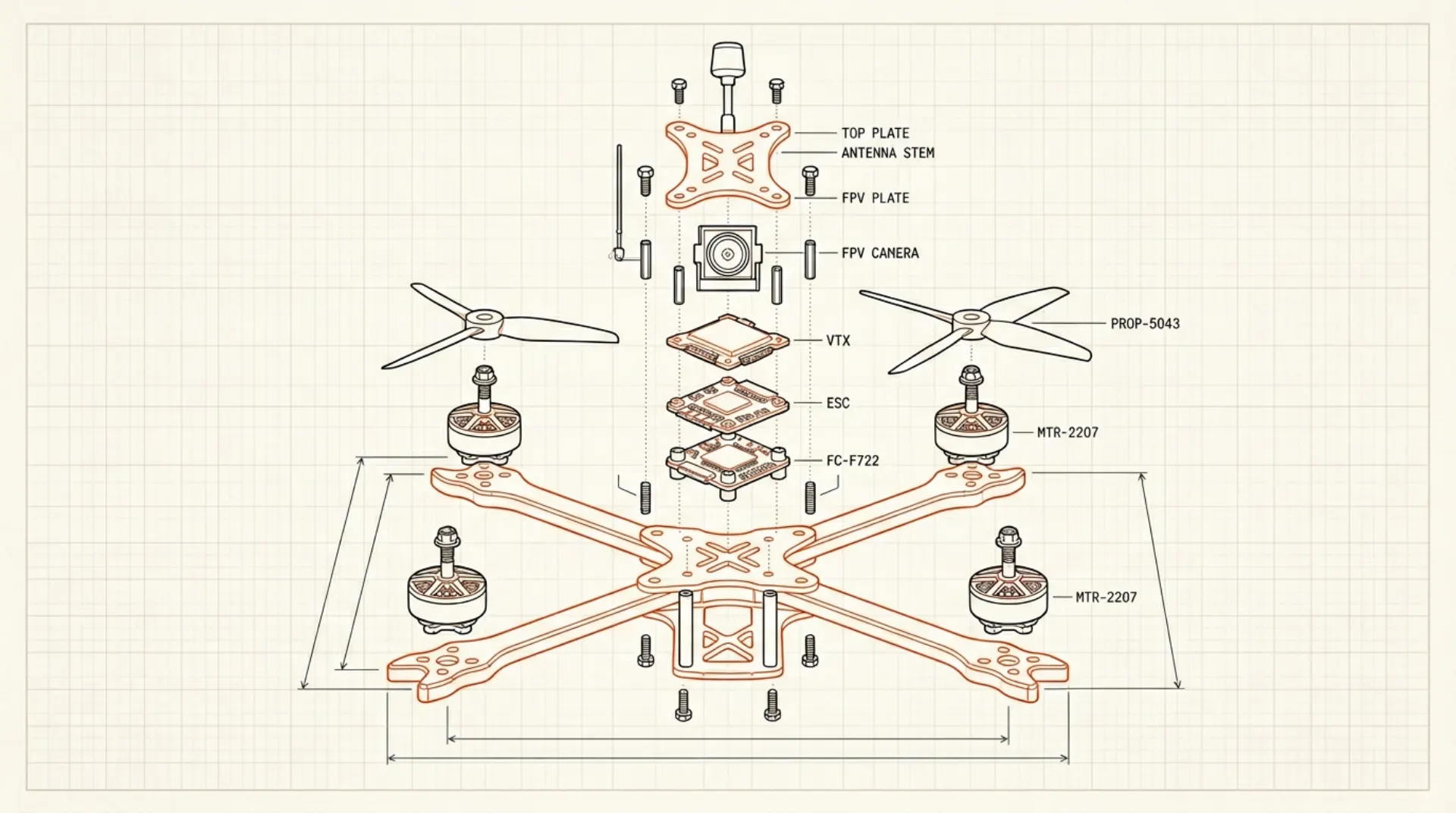
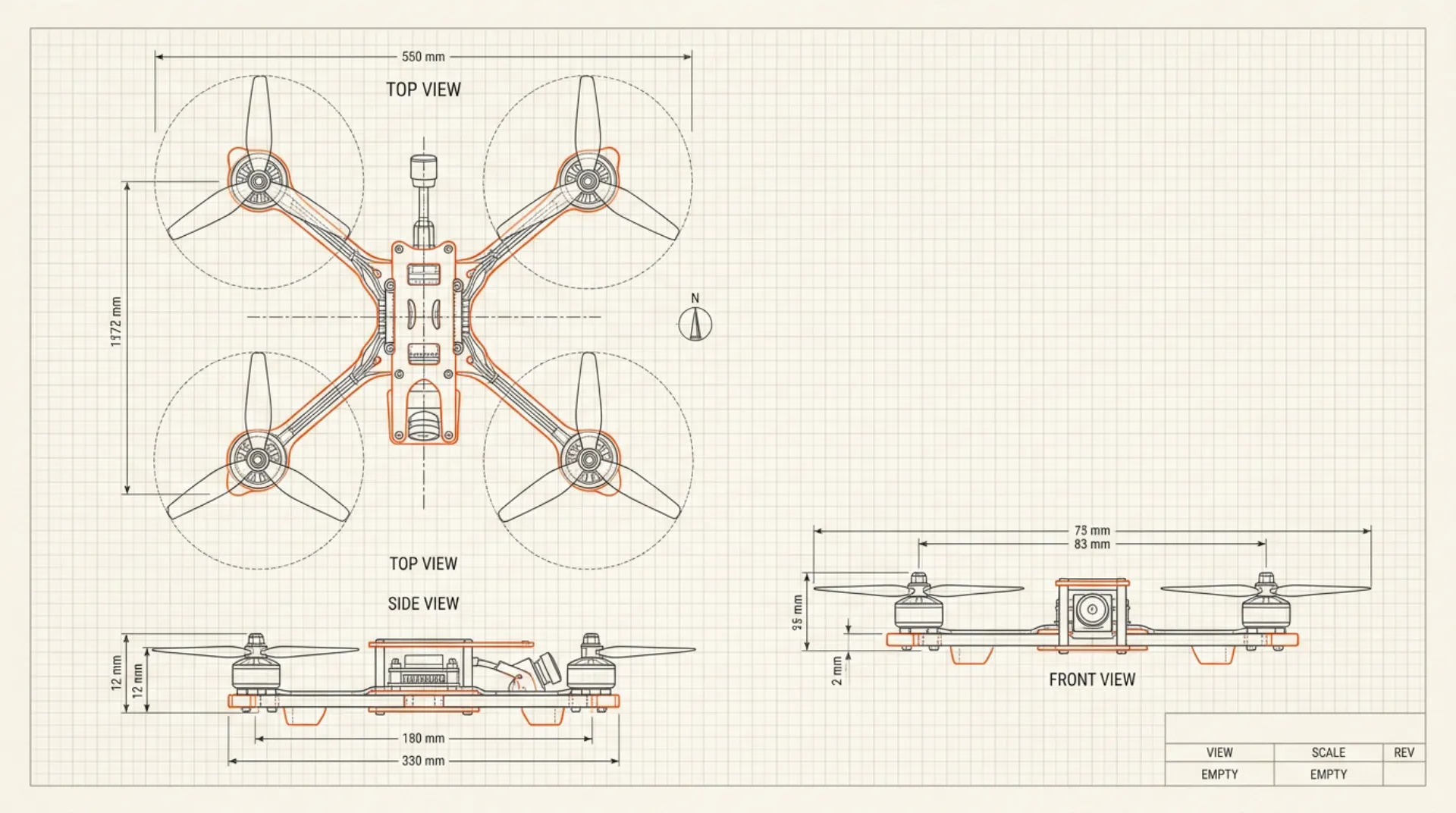
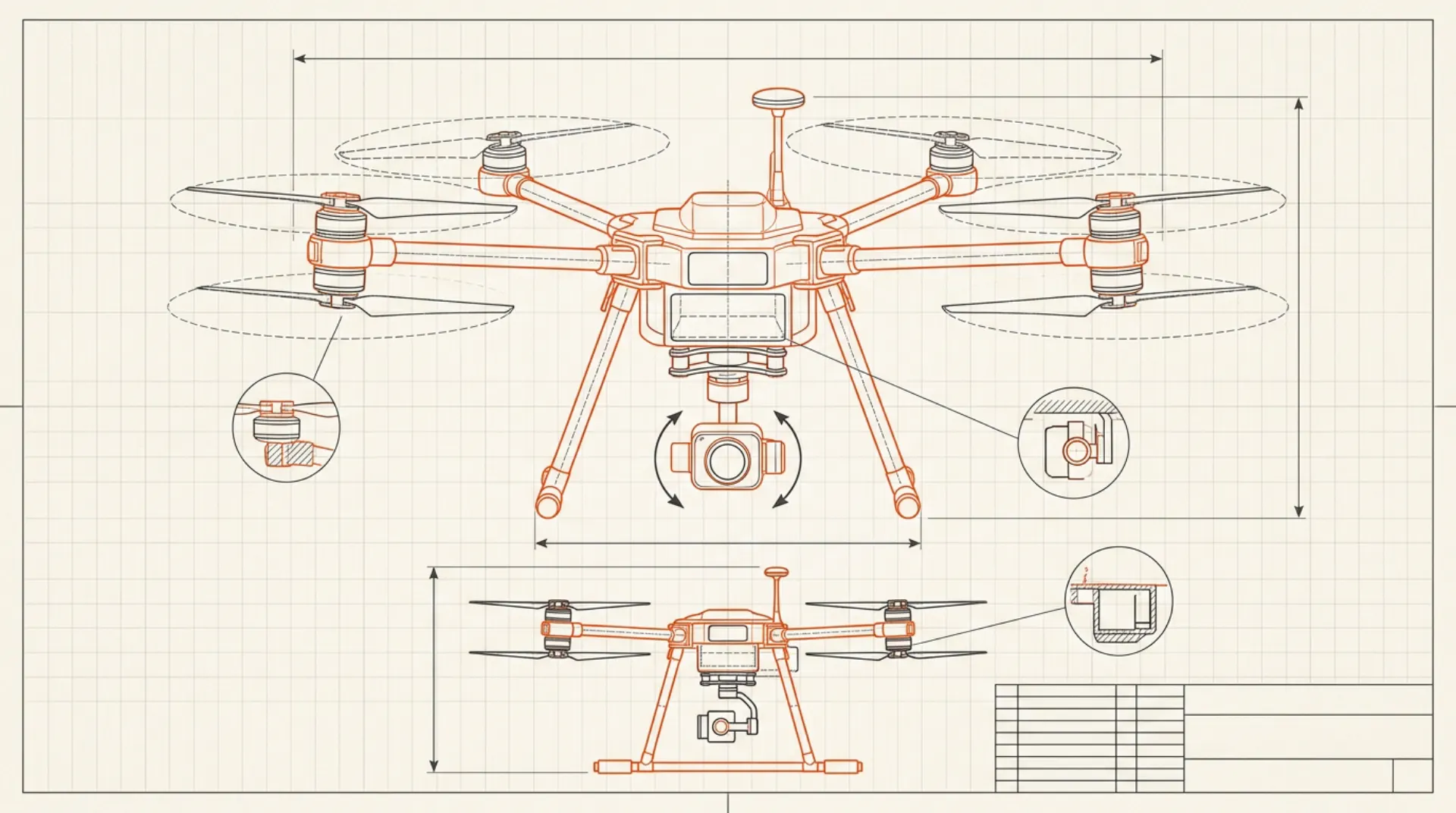
Multirotor

lift: thrust-vectored rotors · operator: remote pilot · form: radial
Shipping now

Multiple fixed-pitch rotors arranged radially, controlled by differential thrust. The canonical hobby and commercial drone. Covers 30 g tiny-whoops through 60 kg agricultural heavy-lift in one consistent control paradigm. Hovers precisely; forward flight is thrust-vectored tilt.

Physics envelope. Lift from radial rotor system. Static thrust per motor derived from stator geometry, propeller diameter, and KV × voltage (see Eq. 3). Power scales with disk loading; efficiency drops at high disk loading. Max speed cap ≈ 200 km/h set by bluff-body drag divergence.

motors
3 · 4 · 6 · 8 (coaxial 2×)
weight
25 g – 90 kg AUW
flight
2 – 45 min typical
build cost
$60 – $45,000
Sub-types
  • tricopterY3 with tail yaw servo · 250–450 mm
  • quadx4 motors · X config · standard
  • quadplus4 motors · + config · cinematic
  • stretch_xRectangular stretch · long-range FPV
  • deadcatForward-offset · prop-out-of-frame for cinema
  • hex6 motors · redundancy + payload
  • octo / X88 motors · heavy-lift · cinema · agricultural
  • Y63 arms · coaxial 2× · redundancy
  • whoopSub-30 g ducted · indoor · swarm
  • cinewhoop2–3.5" ducted · indoor cinema

Form-factor-specific rules

  • prop-clearance · propeller radius vs adjacent-motor distance on the radial frame
  • motor-count · count must match frame type
  • twr · class-specific TWR target (racing ≥ 4 · freestyle ≥ 3 · cinematic ≥ 2)
  • prop-shaft · M5 or M8 conventions matched
QuadX topology · thrust vectors radial

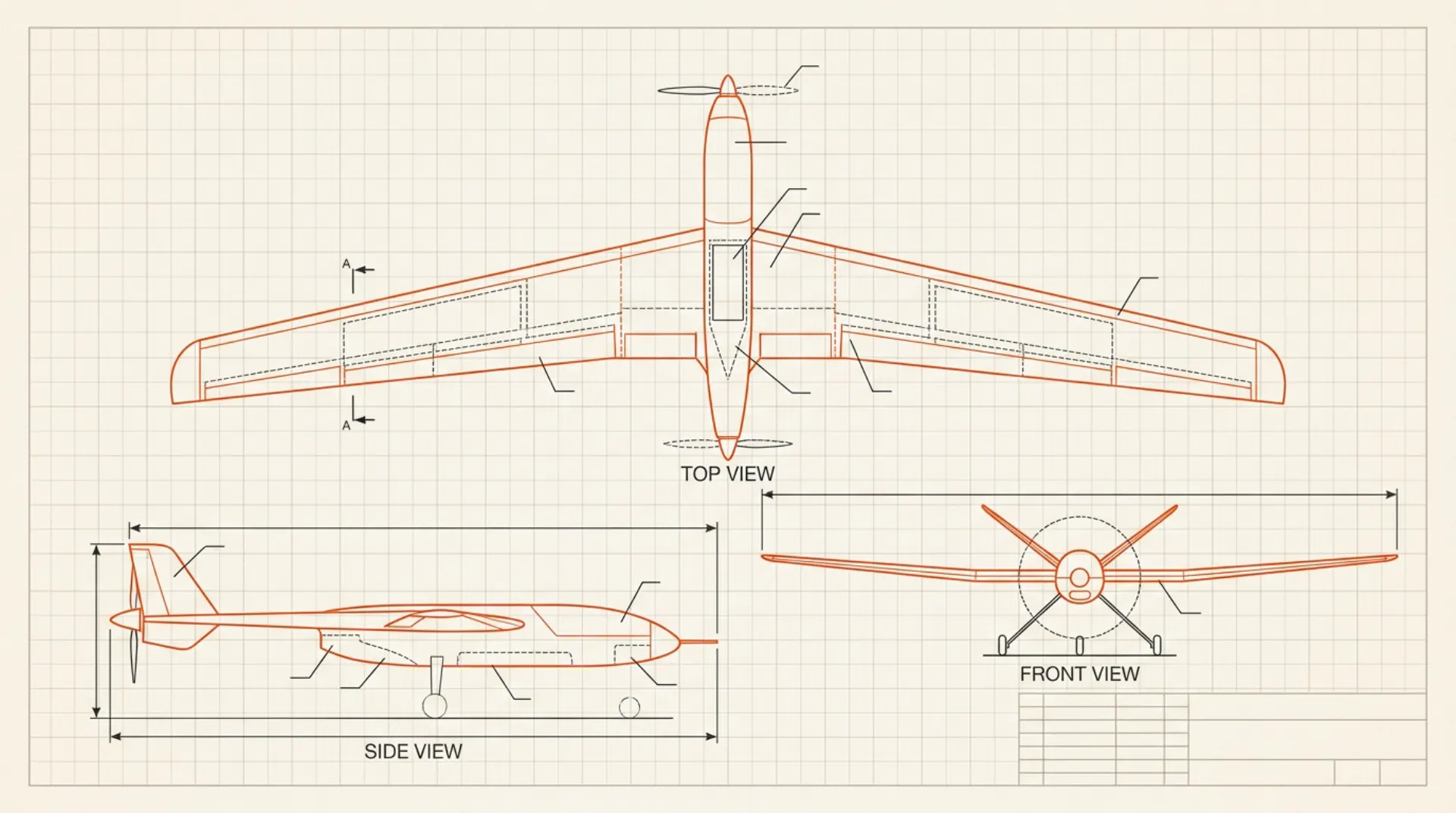
Fixed-wing

lift: airfoil · operator: remote or autonomous · form: airframe with wings
Shipping Q2 2026

Lift produced by airfoil, forward thrust by propeller (tractor or pusher) or ducted fan. The efficient long-distance workhorse. At the same energy budget, a fixed-wing covers 5–10× the range of a multirotor. Trades hover for endurance.

Physics envelope. Steady-level flight with lift L = ½ρV²S·C_L, drag D = ½ρV²S·C_D, stall speed Vstall = √(2W/ρS·C_{L,max}). Range approximated by an electric Breguet analog. Cruise vs hover asymmetry drives the form-factor selection at all acreages > 100.

wingspan
0.5 – 3 m (hobby) · up to 40 m (HALE)
weight
0.2 – 25 kg typical
flight
30 – 180 min (electric)
build cost
$80 – $25,000
Sub-types
  • flying_wingElevons only · delta · 600–2400 mm · ZOHD Dart XL class
  • tractorFront prop · conventional · 3–6 servos · beginner-friendly
  • pusherRear prop · clean nose for sensors · FPV + mapping
  • twin_boomTwo tail booms · Skywalker X8 · Trinity Pro · mapping workhorse
  • biplaneTwo stacked wings · slow-flight · STOL
  • canardFront canard + main wing · research · stability choices
  • box_wingClosed-loop wings · near-zero induced drag

Form-factor-specific rules

  • wing-loading · W/S within class targets (20–130 g/dm²)
  • stall-speed · warns if Vstall > 30 km/h on trainer class
  • cg-mac · CG within 25–33% MAC for conventional layout
  • servo-torque · required control torque ≤ 70% servo rated
  • aspect-ratio · class-specific AR target (delta 2–4 · sport 5–8 · HALE 20+)
Tractor FW · ailerons + elevator + rudder aileron_l aileron_r

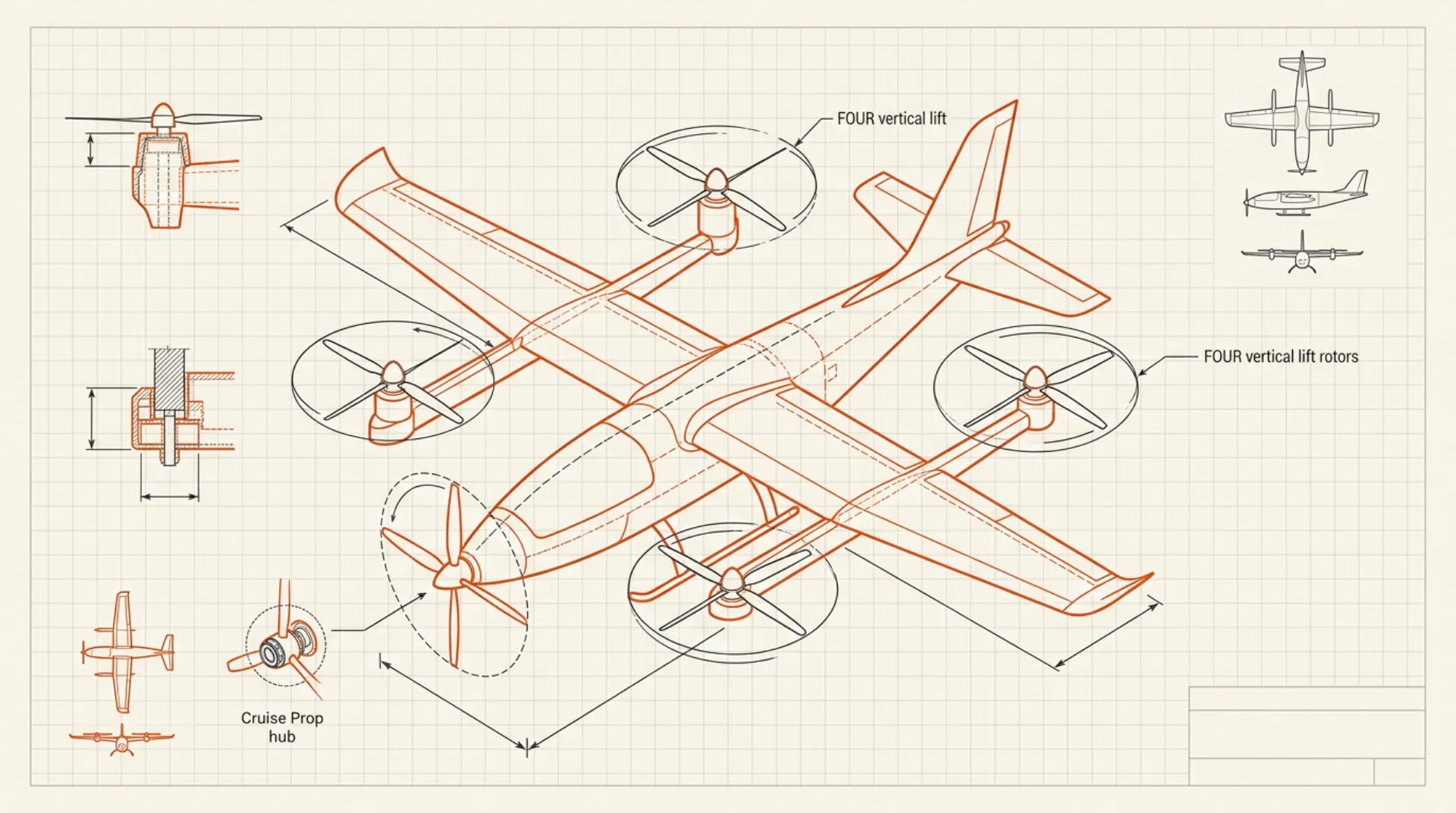
VTOL hybrid

lift: rotor (hover) + airfoil (cruise) · form: dual-regime
Shipping Q3 2026

Vertical launch and landing plus efficient forward flight. The fastest-growing commercial segment: delivery, SAR, long-range inspection. Combines every physics concern from both multirotor and fixed-wing, plus a transition envelope that must be mathematically continuous.

Physics envelope. Hover phase ≡ multirotor rules on lift motors. Forward phase ≡ fixed-wing rules on wing + cruise motor. Transition requires V > 1.3 Vstall before lift motors idle; lift budget L_wing + L_rotor ≥ mg throughout tilt curve; single-motor-fail margin (N−1 lift rotors ≥ weight).

config
quadplane · tilt-rotor · tilt-wing · tail-sitter
weight
3 – 25 kg typical (DIY) · 50+ kg commercial
range
10 – 100 km typical
build cost
$800 – $150,000
Sub-types
  • quadplane4 lift rotors + 1 cruise · simplest · ArduPilot QuadPlane mature
  • tilt_rotorMotor pods tilt 0→90° · Joby S4 scale-down class
  • tilt_wingWhole wing tilts · research · Wisk Gen 6 class
  • tail_sitterFuselage rotates 90° for hover · compact launch

Form-factor-specific rules

  • All MR rules (lift phase) + all FW rules (cruise phase)
  • transition-envelope · V_cruise > 1.3 × V_stall before lift motors idle
  • single-motor-fail · (N−1) lift motors ≥ AUW · hard error
  • tilt-servo-torque · tilt servos ≥ 3× conservative nominal (MKS HV6130 class)
Quadplane · 4 lift (orange) + 1 cruise (violet)

Helicopter

lift: collective-pitch main rotor · yaw: tail rotor or coaxial
Shipping Q4 2026

A single large rotor with variable blade pitch. Aerobatic, fast, highly efficient in hover relative to multirotors, but mechanically complex. The passionate $500–3,000 hobby market uses CP helicopters; commercial agriculture and cinema use them for heavy lift and unique motion quality.

Physics envelope. Disk loading (W/A) 4–7 kg/m² for 3D class, up to 12 for heavy-lift. Tip Mach < 0.7 (≈ 240 m/s). Tail rotor authority: Ttail × Lboom ≥ Qmain × safety factor 1.3. Momentum theory induced power C_P = C_T3/2 / √2.

blade size
325 / 450 / 550 / 600 / 700 mm classes
weight
0.3 – 7 kg hobby · 100+ kg commercial
flight
6 – 20 min typical electric
build cost
$250 – $15,000 hobby
Sub-types
  • single_rotor_cpCollective pitch · swashplate · tail rotor · T-Rex class
  • single_rotor_fpFixed pitch · beginner · simpler · Blade mCX class
  • coaxialTwo contra-rotating rotors · no tail rotor
  • tandemChinook-style · front + rear rotor
  • autogyroUnpowered rotor · pusher prop

Form-factor-specific rules

  • disc-loading · within class target · warns outside 3–12 kg/m²
  • tip-mach · tip speed < 0.7 Mach to avoid compressibility loss
  • tail-authority · Ttail × Lboom ≥ Qmain × 1.3
  • swash-servo-count · 3 for 120°/140° CCPM · 1 for FP head
  • gear-ratio · main gear teeth / pinion teeth = target RPM ratio
swashplate CP helicopter · main + tail rotor

ROV / underwater

lift: buoyancy · thrust: vectored thrusters · form: pressure-rated hull
Shipping Q4 2026

Neutrally buoyant submersibles with thrust-vectoring electric thrusters, tethered to a surface operator via fiber-optic umbilical. BlueROV2 defined the hobby-pro tier. Applications span reef research, wreck archaeology, aquaculture, offshore inspection, and subsea pipeline work.

Physics envelope. Net buoyancy should be slightly positive (fail-safe float) — typically +10 to +50 g. Pressure rating = mission depth × 1.5 safety factor. Thrust sizing ≥ 2× dry weight to overcome drag and ballast. Tether drag at current: ½ρv²·C_D·D_cable·L_cable.

thrusters
4 · 6 vectored · 8 vectored
depth rating
50 – 1,000 m typical
flight time
open-ended (tethered power)
build cost
$1,500 – $25,000
Sub-types
  • thruster_42 horizontal + 2 vertical · entry-level · 50–100 m
  • thruster_64 vectored + 2 vertical · BlueROV2 Heavy class · 300 m
  • thruster_84 vectored + 4 vertical · full 6-DOF · 1000 m
  • auv_torpedoAutonomous · torpedo-shape · no tether · survey

Form-factor-specific rules

  • buoyancy-balance · neutral to +50 g · flag otherwise
  • cb-above-cg · center of buoyancy above CG or roll-over occurs
  • depth-rating-margin · pressure rating ≥ mission depth × 1.5
  • seal-integrity · all electronics inside pressure vessel or IP68 penetrator
  • tether-gauge · conductor gauge adequate for length · voltage drop < 10%
tether ROV 6-thruster vectored · 4 horizontal + 2 vertical

Airship / blimp

lift: buoyancy (helium) · thrust: ducted electric · form: envelope + gondola
Shipping 2026

Buoyancy-lifted aerostat with low-speed electric propulsion. Silent, long-endurance, non-threatening. Used for indoor events, wildlife observation, persistent surveillance, and research. Speeds capped around 30 km/h by drag-cubed power scaling; cruise altitude limited by envelope material.

Physics envelope. Static lift L = (ρ_air − ρ_He) × V × g ≈ 1.02 kg/m³ net lift at sea level. Drag scales as v³; efficient cruise at low speed. Wind tolerance: Vairship > Vwind + Vprogress,min. Ballonet ≈ 10–15% of envelope volume for pressure management.

volume
1 – 1000 m³
payload
50 g – 500 kg
flight time
1 – 24 hours
build cost
$150 – $100,000+
Sub-types
  • indoor_blimpHelium · mylar · 1–3 m³ · trade show · $150–500
  • outdoor_nonrigidHelium · polyurethane · 3–30 m³ · with ballonets
  • rigid_semirigidInternal frame · 50–1000 m³ · commercial scale
  • hybrid_liftHelium + aerodynamic lifting body · cargo
  • hot_airThermal lift · unusual at UAV scale · 10–50 m³

Form-factor-specific rules

  • lift-margin · gas lift × volume ≥ dry weight × 1.05
  • envelope-pressure · pressure drop ≤ 5% over mission duration
  • wind-tolerance · max wind < ½ × cruise speed (else drift > progress)
  • ballonet-size · required for outdoor airships > 5 m³
He ρ_lift ≈ 1.02 kg/m³ Non-rigid blimp · helium envelope + gondola + vectored thrusters

Caged / confined-space

lift: multirotor (inside cage) · purpose: collision-tolerant inspection
Shipping as MR sub-type

A multirotor suspended in a protective spherical or geodesic cage, decoupled via gimbal bearings so the inner craft stays level as the outer cage bumps walls, tanks, or people. Flyability Elios 3 is the reference commercial platform. Application: confined-space inspection — sewers, pressure vessels, boilers, ballast tanks, industrial stacks.

Physics envelope. Inner craft is a conventional quadx. Cage mass reduces TWR by ~15–25%; must be accounted for in thrust sizing. Bearing friction between inner and outer is the dominant non-ideal. Visual navigation relies on onboard lights + SLAM because GPS is unavailable inside enclosed structures.

cage diameter
250 – 500 mm
weight
0.5 – 2 kg AUW
flight
8 – 15 min
build cost
$200 DIY – $30,000 Elios 3

Form-factor-specific rules

  • cage-inner-clearance · inner quad rotor diameter + 20 mm gap fits cage ID
  • twr-cage-penalty · TWR computed against AUW including cage
  • lighting-lumens · onboard LED output sized for enclosed darkness (no GPS, no ambient light)
  • slam-capable-fc · FC with companion computer (VOXL, Jetson) for visual odometry
Caged MR · inner quad decoupled via bearings (orange)

Niche & research

documented for taxonomy completeness · not a near-term ship target
Research

A long tail of form factors we document because they appear in real-world conversations and literature, even if they are not on our roadmap. Some (tethered, nano swarm, heavy-lift agricultural) are already covered as sub-types of the main classes. Others (ornithopter, cyclocopter, monocopter) are genuinely experimental.

ClassWhat it isWhy it existsStatus
Tethered MRMultirotor + power/data cableIndefinite hover for security, events, comms relayMR sub-type
Nano / swarmSub-30 g MR · Crazyflie-classResearch, STEM, Vicon labs, covert micro-ISRMR sub-type
Heavy-lift MRAgricultural octocopter · 20–90 kg AUWSpraying, granular spreading, frost protectionMR sub-type
Solar HALEHigh-altitude electric fixed-wing · 20–40 m spanPersistent stratospheric ISR, comms relayFW sub-type, later
Parafoil / PPGRam-air canopy + pusher propPrecision airdrop, slow-scan mappingResearch
Turbine jetMiniature kerosene turbine FWScale jets, target drones, competition aerobaticsFW sub-type, deferred
Gas IC FW2-stroke gasoline engine FWLong endurance, scale modeling, giant-scale aerobaticsFW sub-type, deferred
H2 fuel-cellMR or FW with hydrogen fuel cell2–4 hour endurance for logistics, surveyDeferred
Compound heliRotor + wings + pusherHigh-speed helicopter alternativesResearch
OrnithopterFlapping-wing biomimicryResearch, biology, covert surveillanceResearch only
CyclocopterHorizontal cycloidal rotorResearch · agile low-noise hoverResearch only
MonocopterSpinning single-wing · maple-seedDisposable surveillance (CICADA)Research only
Hybrid air-groundFlies and drives · rotors as wheelsLast-100-m delivery, indoor mappingResearch only
Sail-drone / USVAutonomous surface sailboatPersistent ocean sensingSeparate product
UGVWheeled / tracked ground robotAg scouting, warehouse logistics, perimeterSeparate product
Manned eVTOLPassenger-class tilt-rotor (Joby, Archer)Regulated as aircraft; out of DRONA scopeTaxonomy only

Pick the airframe by describing the mission.

You don't need to know the difference between a deadcat and a stretched-X, or whether your array wants a quadplane or a fixed-wing. The chat figures it out.

Join waitlist